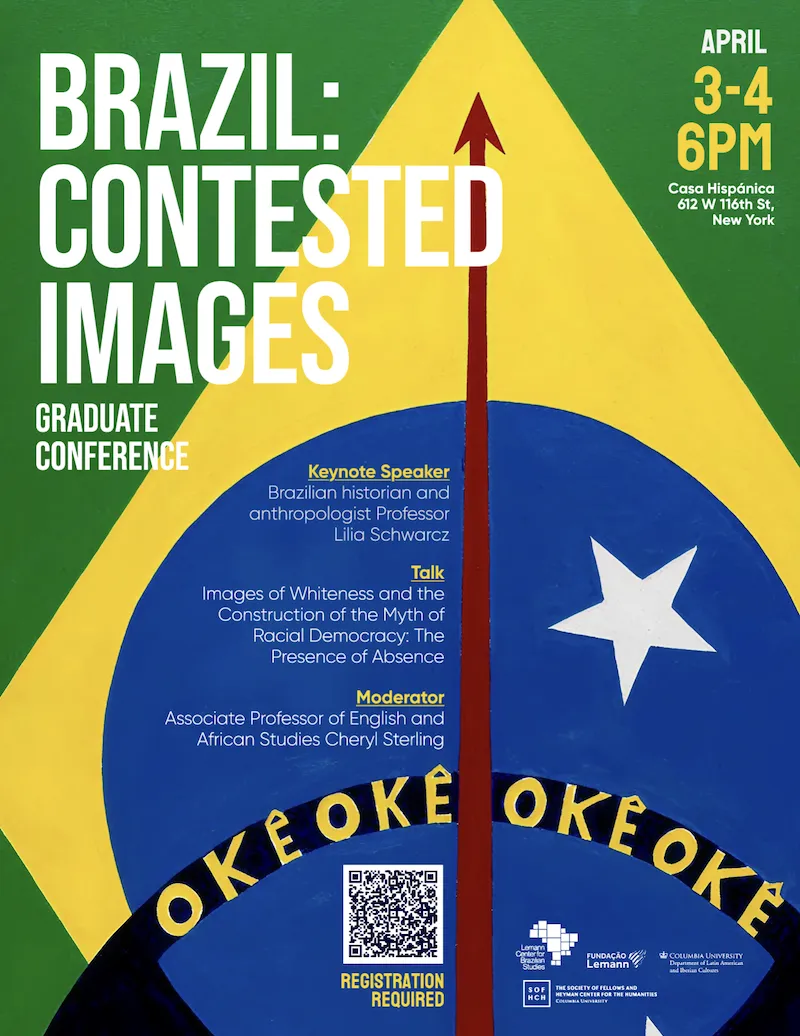
Join us for the first GALAIC Brazilian Studies Conference on April 3 and 4, 2026. The event will open on Friday at 6:00 PM with a keynote lecture by Brazilian historian and anthropologist Professor Lilia Schwarcz, titled “Images of Whiteness and the Construction of the Myth of Racial Democracy: The Presence of Absence.” The session will be moderated by Associate Professor of English and African Studies, Professor Cheryl Sterling, and will be held in English.
On the following day, from 8:30 AM to 6 PM, Casa Hispánica will host a full program featuring 8 panels and 32 presentations by graduate students from universities across Brazil and the United States, selected from more than 65 abstracts submitted. Breakfast and lunch will be provided, and the conference will conclude with a closing reception.
Please note that registration for both the Keynote Lecture and to attend the second day is required.
About the Conference:
The global geopolitical landscape has been marked by attacks on multilateralism, the strengthening of rigid national identities, and growing violence against immigrants, women, racialized people, and the LGBTQIA+ community. In contrast, resistance movements led by these groups continue to echo, seeking to build responses to global neoliberalism—proposing forms of community action, occupation, and intervention in public and private spaces, such as streets, museums, galleries, and virtual platforms for aesthetic and political interaction. In recent years, Brazil has been deeply affected by these disputes, experiencing an attempted coup in 2023—in addition to external threats to national sovereignty—which reactivated debates around our constitution, our sense of nationhood, and the fragility of our history with a democratic tradition.
In this context, an aesthetic-visual regime emerges, marked by the strategic choice of words as political force and by the circulation of mobilizing images—ranging from representations of the Escrava Anastácia, popular cult to Anastácia Livre and her new regime of visibility; to the production of films by the Maxakali, Kuikuro, Guarani-Kaiowá ethnic groups and so many other indigenous artistic expressions that have proliferated and gained prominence in the last three decades; to the consolidation of a network of far-right videos disseminated in WhatsApp and Telegram groups; and, furthermore, to the political performance that, on January 8, in the Planalto Central shattered the symbols of the republic.
Notions of Brazilian identity are strained by the accumulation of images offered in contemporary times. Individual and collective subjectivity are put to the test to understand what it means to be Brazilian in an interconnected virtual universe, where disputes over visual narratives about the self and the other are accentuated. Images thus act as a vehicle of national significance. Inseparable from brazilwood, the word "Brazilian" arises, from the beginning, from the confluence between indigenous bodies and native flora to be commercialized. Forever intertwined with this colonial grammar, Brazilianness develops in this suspended interlude between physical and symbolic deaths, converting national identity into a wound that never stops hurting.
These disputes surrounding Brazilianness go beyond the scope of national identity itself: they encapsulate anxieties, desires, and contradictions inherent to the contemporary global experience. Thinking about Brazil, its images, and aesthetic disputes is, therefore, also approaching the codes and conflicts that mark the experience of our present time in a broader way.